Monday, 1 October 2012

Dovecot's century

On Friday morning we walked the charming cobbles of the Grassmarket and up through the winding steps to North Bridge and then to Infirmary Street to the historic Dovecot Studios, now successfully housed in a complex that used to be the Edinburgh Baths. This beautiful new incarnation of the studio was financed by a private benefactor, Alastair Salveson. With a huge timbered floor space and generously proportioned mezzanine area that surrounds it, it has found a home that compares very well with the gracious interior of our own Australian Tapestry Workshop. Clever management of the surrounding spaces that include exhibition areas, a coffee shop and even apartments mean that income from the whole building subsidises the survival of the tapestry studio.

The main attraction at the moment is the 100th anniversary exhibition, Weaving the Century, which is presented in three large downstairs spaces and also along the upstairs mezzanine that runs above the studio space. I was eager to see how many of the older tapestries would be there as I had experienced first hand knowledge of many of the works from the previous large retrospective in 1980, Master Weavers. At that time I was living in Edinburgh and studying at the Edinburgh College of Art, and my ex - husband photographed the catalogue, an exercise that took us to stately homes and castles including Mt. Stuart on the Isle of Bute, the ancestral home of the Marquess, the Dovecot's first patron, to photograph the magnificent Lord of the Hunt tapestry. An enormous work measuring over 32 feet, it was commenced in 1912 and finished after the first world war in 1924, the two original weavers having lost their lives during the war. Sadly this tapestry was not part of the current exhibition.


We had a very well informed guide, Francesca, who is doing a PhD on the history of the studios. Curated by art historian, Dr Elizabeth Cumming, there are over sixty tapestries in the show. The oldest work is the very impressive The Admirable Crichton that dates from 1930 and was woven over a period of three years. An expansive tableau, it looks like a still from a film and honours James Crichton, a forebear of the Bute family. Its rich design demonstrates the enormous skills of the weavers and the quality of their production. A large, framed sampler also emphasises the rigorous training of apprentices at this time.


Photography was not permitted in the exhibition area, but it was exciting to see the artistic evolution of the Studio as it worked through the design fashions of the 1940s, to the 1950s under the aesthetic guidance of Sax Shaw, and towards what must be seen as its hey day under the directorship of Archie Brennan from the early 1960s. Starting as an apprentice and soon becoming a distinguished artist and designer in his own right he brought a new vitality to the process through his informed insight into the medium and his intelligent collaboration with leading artists of the time including Eduardo Paolozzi, Harold Cohen, David Hockney and Louise Nevelson. These works still have the ability to take your breath away, and as a former production weaver I once again had the opportunity to appreciate how thoroughly the designs had been assessed and explored and how far away they are from mere reproductions of the artists' work.


The newest tapestries are hung out of the main exhibition rooms, around the wide mezzanine that surrounds the actual workspace. Colourful, experimental, textural, and sometimes three dimensional, they display a variety of approach and a desire to engage with contemporary art in all its eclectic forms.


Studio views


After seeing the exhibition we went down onto the studio floor and weaver, Jon Cleaver, demonstrated the basic technique of tapestry weaving to the group. This was particularly useful to four of my participants who had not woven before. We were then able to view work in progress and rugs that were being tufted with a gun at the rear of the studio. There is a large tapestry entitled Large Tree Group on the loom designed by Victoria Crowe as a mark of the centenary of tapestry at Dovecot. The yarn has been sourced from fleece all around the UK to form a palette of natural colour in undyed wool. A snowy scene is emerging as a bleak figure trudges towards a stand of bare trees.

 Jon demonstrates tapestry technique
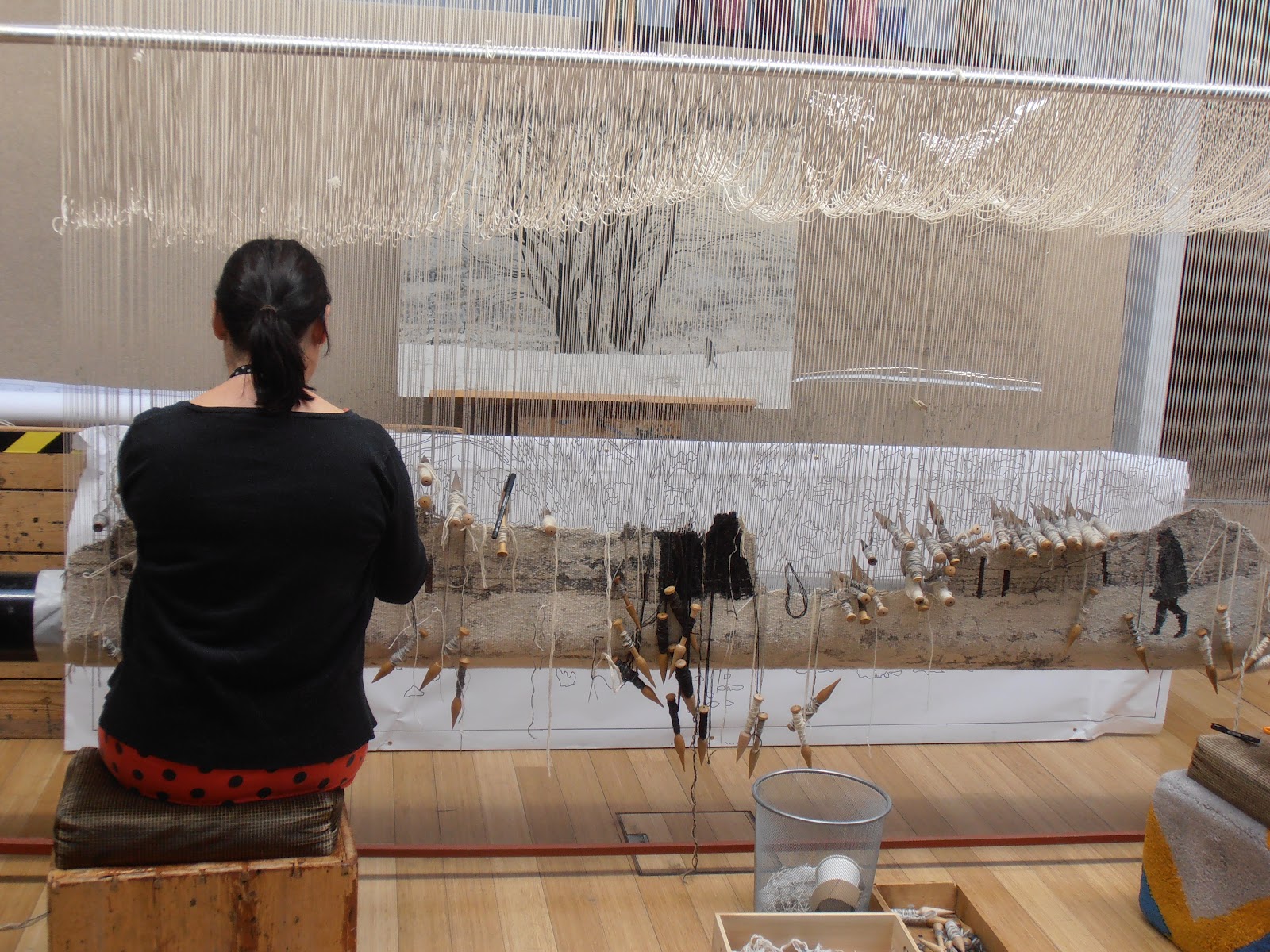

Victoria Crowe tapestry in progress


At the conclusion of the viewing we were able to have a sandwich lunch in the meeting room - a lovely, light filled space with sleek, modern furniture - during which the Director, David Weir, popped in to greet us. I first met him when I visited in 2009, and it was very good to see that the whole complex is thriving under his leadership. My thanks to Kirsty Sumerling for arranging a very well planned and enjoyable visit.


Wednesday, 12 September 2012

Visits to Edinburgh Tapestry Artists

On Thursday morning we made our way to King's Cross station to catch the 10 o'clock train to Edinburgh. The service in first class was smooth and pleasurable and we were plied with food and drink for the four hours of the journey. After checking into the very comfortable surroundings of the Apex City hotel in the Grassmarket which boasted views of the Castle atop its steep rock, we piled into taxis to visit Linda Green at her home and studio. The ride took us picturesquely around the huge mound of Holyrood Park, its vast green slopes both a rugged and gentle backdrop to the eastern side of the town.

I have long been fascinated by Linda's three dimensional woven constructions and her ability to "draw"with myriad slender threads that weave around themselves into delicate grids. Now she is surprising us with a new body of work in which she explores the potential of phragmites, a reed native to the waters of the Neil Garden at Duddingston Loch, where she has been resident for the past few months. Over a season she has immersed herself in nature and in particular the properties of the reed, drying, splitting and weaving them to discover their potential. It has led her to experimenting with weaves recorded by Theo Moorman in her quest to transform plant material into woven cloth. Most exciting are her prints of the reeds as viewed through a microscope, which, in turn, have resulted in a series of sensitive drawings. Her investigation has culminated in an exhibition at the Edinburgh Botanical Gardens this summer aptly entitled From Straw to Gold.

Linda is a keen gardener herself, and her upstairs studio overlooks the results of her labours, a profusion  of colour and leaf that spills out of ordered beds that have been carefully tended over the years. We were fortunate to enjoy her warm hospitality and share a little of the magic she creates in her thoughtful practice.


Linda in her studio with drawings

On Friday afternoon we visited the WASPS studios which are housed in an old bakery building converted into a gallery and artists' studios that have subsidised rent, allowing the residents a relatively inexpensive area in which to produce their work. I had not met Jo Barker before although I have followed her work for some time.

Also a graduate from the Edinburgh College of Art, her distinctive imagery combines a tracery of swirled lines and dots that oscillate over dense ovals and circles which combine to form colour saturated tapestries. To arrive at these unique designs she uses techniques of drawing, painting, collage and digital manipulation. She showed us many small sketchbooks which contained repeated explorations of colour and form. Because the visual impact of the work relies heavily on the translation of colour, her yarns have to be chosen in a very particular manner for their density and light absorption qualities.

Jo also spoke of an inspirational recent trip to Egypt where she was able to view the Wissa Wassef studios and experience the light and colour of another, very different country.


Jo in her studio

Upstairs we were welcomed into Fiona Hutchison's studio, which is draped with her exploratory ventures into capturing the essence of moving water. She is a sailor and is inspired primarily by the sea, swathes of blue "stuff" abounds and she herself, dressed in blue, animatedly communicates this passion.

She explores the surface of the sea and its light reflecting qualities through the use of textured materials such as sisal and tracing paper which has been painted, coiled and threaded. A prolific exhibitor and inspired teacher she is generous in talking about the methods of her process and held us spellbound with her explanation of how she experiments to create her three dimensional pieces.


Fiona talks about her work

Although we were unable to meet her we were also able to view Sara Brennan’s work at WASPS. Her tapestries appear as muted horizons - like paint dragged in one colour over the surface of another. Woven in monochromatic scale, her marks explore subtle nuances made deliberate by the carefully constructed weaving.


Our last visit was to Joanne Soroka who has recently published an excellent book on tapestry entitled Tapestry Weaving - design and technique. She had displayed a couple of large tapestries for us to view in which she explores her mixed ancestry through motifs as diverse as scratched rock and rusted metal. She also showed us a new series of small experimental works that employ texture and gilt coloured yarn.


Joanne Soroka

Monday, 10 September 2012

A day at Court

On another breathtaking London day we made our way to Hampton Court Palace to see the wealth of tapestries housed there. I had tried to organise a viewing of the tapestry conservation studio but that was not possible due to their heavy work load. Instead we had a charming guide, Siobhan Clark, who took us around the palace to see the the tapestries in the context of the building and its history.

The most famous suite, The Story of Abraham, was commissioned by Henry VIII and ten tapestries was completed in Brussels around 1543 in the workshop of Willem Pannemaker after designs by Pieter van Elst. They depict scenes from the life of the prophet Abraham drawn from Genesis, chapters 12 - 24.

It is believed that Henry may have used the story of Abraham's Covenant with God as a way of legitimising his own rule following his break with the Roman Catholic church in 1530 to reinforce his own direct God given right to establish the Church of England. In addition, the symbolic passing of Abraham's rights to his son Isaac became a metaphor for succession of the Tudor dynasty from Henry to his son Edward. His collection of over 2,000 tapestries were used as a great display of wealth and power and sent a strong political message to foreign visitors to the Court. A hundred years after Henry's  death the Abraham suite alone was valued at over 8,000 pounds.

Later they were used by generations of kings as a backdrop to their coronations at Westminster Abbey and were often paraded through the streets in processions. The richness of their design and use of silk and gilt metal- wrapped thread made them appropriately splendid for these occasions. When Queen Victoria opened Hampton Court Palace to the public they found their permanent display in the Great Hall and recent conservation has restored their full glory.


Tapestry details                                                                                                            


The vast palace was originally built in the Tudor style and developed by Cardinal Wolsey from 1514, then added to in the Baroque style by Christopher Wren who transformed the east and south facades in the late 1600s for William 111 and Mary 11. It has quite a schizophrenic appearance, the grand style of Wren pasted on top of the more utilitarian red brick foundations of its original form. Every space is, nevertheless, imposing in dimension and grandeur.

After viewing the interior we had lunch in an open air cafe that sits at the end of a large, walled rose garden. The roses were a little past their prime but their scent was overwhelming.


Views of the Palace


A sun drenched stroll through the extensive gardens was the last pleasure that awaited us. We made our way through a succession of sculptured, contained spaces - the Knot Garden, the Privy Garden and the Pond Garden towards the Great Vine, a hefty thatch of leaf and fruit that was planted by Capability Brown in 1768. It was fairly dripping with plump, purple grapes that are sold in the various shops on site.


Garden views

And somewhere in the vicinity of his Great Fountain Garden we caught up with the great man himself, wide of girth and keen of eye with much to say to his attentive subjects!


Friday, 7 September 2012

Visiting Anna and William

Tuesday was a big day on the trains, to make visits to two artists who both graduated from the  Tapestry Department of the Edinburgh College of Art, a generation apart. Their current practice reflects the diverse nature of that education, where exploration was valued and encouraged.

First we travelled north to Rickmansworth in Hertfordshire to visit Anna Ray, a lovely young woman whose very unusual work has impressed me immensely over the last few years. Her sculptural pieces comprise tubular stuffed structures made of cloth that draw on the viscera of the body as their source of inspiration, their writhing forms appearing organic and alive. She builds her work piece by piece until they reach a satisfactory size. Irresistibly tactile, her work entitled Knot draws excited physical response wherever it is exhibited, even in the chaste surroundings of a chapel in Italy.


Extremely articulate and organised, she speaks intelligently about the emotional journey of her art with great intensity. As a counterpoint to her bold fabric pieces she surprised us with a series of delicate embroideries entitled In the Garden drawn from a residency at the Winterbourne Botanic Garden in Birmingham in 2004. Their fine silken stitches emulate the subtlest of drawn and painted marks.


Visiting the studio

We then walked across some acres of sun drenched parkland to the station, stopping for lunch at an open air cafe. The journey back to Kew Gardens was quite arduous with a few changes along various tube lines, but we eventually emerged at the pretty station entrance and made our way along a flower filled street to William Jefferies' studio, a shared space in a multi level old school building.

William is a tapestry artist who was setting standards in his creative use of the medium thirty years ago and is still pushing the boundaries with his beautiful shaped and textured pieces today, employing a rich combination of form and shape to evoke illusion. 


He had assembled a huge array of samples for us to see his working process. His tapestries go against every conventional idea of what tapestry is, or should be. Woven on an upright frame, they comprise heavily textured, irregularly shaped (sometimes undulating) constructions that contrast bright colours of fine wool and lustrous cotton against the earthy textures and neutral tones of rope and sisal. They are totally unique in their conception and construction, and William, a charming and generous host, talked to us at length about his work that is also inspired by collaged collections of small objects. 


Wednesday, 5 September 2012

Images from the V&A


A sunny day at the V&A

We started our visit at the Mediaeval and Renaissance galleries, which display textiles, metalwork, sculpture, enamel, satined glass and ceramics in the context of their time, and trace the evolution of these arts and crafts until the 1400s.

There are exceptional examples of Coptic tapestry, two burial tunics that illustrate both the applied and integral forms of woven decoration in tapestry technique, portrait panels of Adonis and Aphrodite that are superb in their characterisation with faces you feel could be recognised on the street today, and  exquisitely woven medallions full of detailed action that make contemporary efforts pale by comparison

Large cases display examples of English embroidery, a wonderful stitched quilt in "trapunto" technique from the 1300s that pictures a narrative of battle, and the famous Syon cope, magnificently detailed in its execution, combining satin stitch with a border of the minutest petit point.

Other tapestries of interest are a naive German panel that dates from 1490 and believed to be woven by nuns, telling the story of a woman's spiritual journey from fashionable lady to novice nun, and the  beautiful Scenes from the Passion of Christ woven in France between 1400 and 1425. It combines three scenes - the deposition, the burial and the resurrection - into a continuous work. The rendering of the faces, figures, and the transparency of cloth is amazingly sophisticated and exquisite in every detail.

The gallery culminates in the magnificent Boar and Bear Hunt from the Chatsworth Hunts, which occupies the entire back wall of the gallery and is splendid in its execution and detail. An upstairs gallery houses the other three pieces in the suite - Falconry, Swan and Otter Hunt and Deer Hunt, the whole measuring 133 feet in length.  Believed to be woven in Arras or Tournai between 1430 and 1450, the designs were inspired by the manuscript attributed to Gaston de Foix (1331 - 1391). For many years the tapestries were housed in Chatsworth House, Derbyshire, home of the Duke of Devonshire, and were thought to have travelled to England with Marguerite of Anjou when she married Henry VI in 1444. This theory has since been disproved through examination of the costumes depicted in the earlier tapestries of the suite.

The weaving devices used to render the most extraordinary richness of silks, velvets and brocades make every tapestry an excuse to enact a costume drama of enormous proportions. The details of the clothing reflect the changing fashions of the two decades in which they were designed and created.

The subject matter is an intricate reflection of the importance of the hunt as court ritual. More than a pastime, hunting skills were highly regarded as an exhibition of ability to perform in conquest, as well as having the practical outcome of contributing game for the dinner tables of the aristocracy.


We had our lunch in the splendid Victorian circular room that serves as a cafeteria - every inch of it is covered in decorated ceramic tiles, so overblown with pattern and colour that it verges on complete decadence. The outside courtyard also beckoned, bathed in bright 25 degree sunshine. A crowd of young children splashed in the shallow pool all day, their exuberance ringing through the serious halls of antique treasures.


Afterwards we viewed the Raphael Cartoons for the Acts of the Apostles, sombre in the vast hall that houses them. Commissioned by Pope Leo X in 1515, Raphael designed ten tapestries illustrating the Acts of the Apostles to decorate the side walls of the Sistine chapel. The master weaver, Pietr Van Elst, of Brussels, was commissioned to simply copy the paintings without any freedom of interpretation.  Tapestry weavers bowed to the Renaissance domination of painting, finding satisfaction only in flawless reproduction.

The popular success of these tapestries led to the replication of these cartoons in woven form many times over in the following century. One example, The Miraculous Draught of Fishes, woven at Mortlake in the 1600s, hangs alongside the cartoons, barely indistinguishable from them except for its swirling Baroque border.

Upstairs, in the British rooms hangs a small William Morris tapestry, Angeli Ministrates, designed by Edward Burne - Jones with a background and border by weaver and designer John Dearle who was Morris' first apprentice. Morris' philosophy allowed the weaver, once again, to make an important visual contribution to tapestry design.

Other delights to be experienced at the V&A were the newly redesigned Fashion and Textiles area and a gorgeous exhibition -  Ballgowns : British Glamour since 1950, which flamboyantly displays sixty years of stylish evening wear. 


Monday, 3 September 2012

On the way to the V&A

Yesterday was the first official day of the tour and the weather man predicted "a cracker of a day". 
And so it was - a sunny 25 degrees! I collected my nine delightful companions in the lobby of the hotel and we set off down the road, a five minute walk to the hallowed portals of the V&A, past the magnificent Natural History Museum, its tessellations of pastel bricks glowing pink and blue in the morning air.

There is an impressive installation in the grounds entitled The Lionheart Project, a monumental re creation of the Three Lions royal crest, three caged beasts created in crochet! Made by artist Shauna Richardson and entitled Crochetdermy, the project "celebrates the rich textile history of the East Midlands". Using a 10 mm. crochet hook and thirty six miles of yarn, it took two years to complete. It didn't sound like long enough to us!

I took some photographs under difficult conditions, the glass cage reflecting the patterns of everything around it.

lionheartproject.com