Friday, 1 February 2013

Angers - Cathedrals and Courtship


A short train trip from the Gare Montparnasse brought us to Angers, the delightful Mediaeval town in the Loire valley. Its castle houses The Apocalypse, one of the wonders of surviving 14th century craftsmanship - the enormous, poetic tapestry illustrating the book of Revelations in seventy panels.

As we came out of the station in search of taxis several young people in very fancy dress greeted us noisily - there was a lot of whooping and cheering and the distinct evidence of flour bomb debris all over the pavement. We made a hasty escape, but the University "rag" would catch up with us later in the day, fortunately in a very benign way!

After settling into the Hotel du Mail, a charming country hotel built in the style of a manor that occupies two sides of a cobbled courtyard, we walked across the lovely old town to the Cathedrale St. Maurice that contains eleven Gothic tapestries, an imposing Romanesque/Gothic landmark at its centre. The west portal is crowned by two tall towers and a smaller central one that sits on a figured base. Inside, the spare, grey stone walls sweep upwards in true pointed arch manifestations of the Gothic style, yet the high altar shines in showy excess. Designed in the Baroque style in 1758, six marble columns support an intricately gilded canopy.

The tapestries form one of the most famous and precious collections in Europe, and were woven between 1376-81 for the cathedral. However, they are not all on regular view. The illustrations were drawn by Jean Bondol, based on an illuminated manuscript, and the weaving was overseen by Nicolas Bataille whose workshop also produced the acclaimed Apocalypse. More overwhelming was the display of stained glass windows crafted between the 12th and 16th C. with some 20th C. replacements made after the second world war. There is a distinctly reverential atmosphere within the vast space, and the amalgam of styles takes nothing away from the quiet serenity within.


The west front with 15th C. twin towers, 70 and 77 m. high


Sculptures of St. Maurice and his companions


Gothic interior with Baroque altar on the right.

The front of the cathedral faces a sweep of shallow cobbled steps that descend to a pretty fountain in an open square. We sat along the rim of water in gentle Autumn afternoon sunlight, enjoying a view of a shaded park and listening to the high hilarity of a few dozen young people cavorting around.


 The steps and fountain

With absolutely no warning, ten handsome young men descended on our sixty something group, kneeling in front of each of us and singing, in unison, a pledge of undying love with great gusto and feigned emotion. At the finish they demanded our telephone numbers!


The serenade

After being courted we ambled slowly back through the main square, stopping at shops that sold interesting handmade toys and embroidery wools, and indulged in generously scooped cones of delicious ice cream. We dined at a tiny Greek cafe that I had visited previously, the owner apologising that he had no staff that evening and that the menu would be limited. He turned out great plates of souvlaki lamb and salad, as authentic as you could wish, served with homely hospitality and a warm smile!


Friday, 18 January 2013

Musee des Arts Decoratifs


Our last day in Paris included a visit to the Musee des Arts Decoratifs that shows the very best of the decorative arts, an overwhelming display of skilled craftsmanship from the very old to the very new. A short stroll from Rue Moliere down the Avenue de L'Opera to the Rue de Rivoli, we were there in no time at all and filled in a happy half hour exploring the glamorous shops in the Carrousel du Louvre, an underground arcade that leads directly to the I. M. Pei glass pyramid that forms the contemporary entrance to the Musee du Louvre.

The Musee des Arts Decoratifs is housed in part of the original palace that flanks the Rue de Rivoli and opens out onto the spacious Tuileries gardens. It is a treasure trove of decorative art encased in 18th century elegance. We made a delightful, leisurely stroll through time in this palace of riches, viewing relief sculpture, paintings, ceramics, wood, ivory and enamel work, glass, furniture and textiles that span centuries of civilisation from the Middle Ages and the Renaissance, the seventeenth, eighteenth and nineteenth centuries, to the innovations of style and techniques of Art Nouveau and Art Deco, and finally to the funky modern furnishings of the sixties, seventies, eighties and nineties of the twentieth.


The Musee

For tapestry lovers the Mediaeval rooms are particularly rewarding, resplendent with "courting couples" tapestries and the recreation of a Mediaeval bedroom with woven hangings and bedcovers. Dating from the end of the 15th C. most of the furnishings were acquired from the Chateau of Villeneuve - Lembron in the Auvergne. The interior contains a canopy bed, bench, chest and dresser placed contextually around a fireplace with carved wooden mantel. Five pieces of narrative tapestry adorn the walls, woven in Paris in 1420 and illustrating courting themes from The Romance of the Rose. 


 Mediaeval bedroom


Other mediaeval tapestries depict pastoral scenes including wood chopping and grape gathering. Les Vendanges (Gathering the grapes) was woven at the beginning of the 16th C. in Tournai. In a small room that displays panels of inlaid wood and small mediaeval portraits hangs a brilliantly detailed tapestry entitled Le Festin, depicting a feast, possibly in celebration of the return of the Prodigal son. Woven in silk and wool, it dates from 1510 - 1515. Two large "grotesque" tapestries occupy the walls of the salon dedicated to the late Italian Renaissance. They serve a purely decorative function as the rich narratives of the previous works give way to a more ornamental style.

More treats in store include the wealth of Art Nouveau and Art Deco exhibits, including a Caldor rug woven in Aubusson, and a complete recreation of Jeanne Lanvin's Paris apartment.


 The Lanvin apartment

In 1924, The fashion designer Jeanne Lanvin commissioned the decorator, Armand Albert Rateau to redecorate her apartment at 16, rue Barbet de Jouy. His designs were drawn from the eclectic influences of antiquity, the East, and floral motifs, and incorporated the use of rare materials such as marble and bronze as well as beautiful textiles. The bedroom and sitting room are draped with silk in the trademark "Lanvin blue", exquisitely machine embroidered in the designer's workshop in a delicate drop of white palms, roses and marguerites. When the apartment building was demolished in 1965 the beautiful four room suite was relocated to the Musee and presented in an authentic a style as possible.

Art deco stained glass panel celebrating the manufacture of tubular steel that revolutionised furniture design between 1926 and 1931.

Panel detail

One of my favourite rooms in the Musee sports a collection of 1960s chairs, mostly made from moulded plastic, the new material that was all the rage at that time. Accompanying the ultra modern, shaped chaises is a collage of film clips from the 60s and 70s in which each of the chairs that you are encouraged to sit in and watch, "stars" in movies from the era. It is frankly hilarious and totally fascinating, ranging from James Bond to Woody Allen. At the end the credits roll, paying homage to the designers and manufacturers of each "starring" chair!


Julia in a sixties suspended plastic bubble chair

 After lunch at a nearby restaurant we enjoyed the gardens surrounded by the wonderful Maillol nudes that sprout abundantly through the manicured foliage.


 Maillol nudes


View over the gardens from the Musee


At the Musee de la Mode et du Textile that adjoins  the Musee des Arts Decoratifs there was a very comprehensive tribute exhibition to the designer Louis Vuitton that traced his rise from a designer of luggage and handbags to fashion, and his influence on the contemporary designer Marc Jacobs. It was like entering a shimmering grotto that seemed to incorporate mirrors on every surface and throbbed to a loud disco vibe. Quite disconcerting for the viewer and obviously designed as an "experience" for the younger generation.

 Before we left Paris we had a stunning meal at Gallopin in lieu of our inability to book at the aforementioned Le Grand Colbert. Served with great style and elegance in a chandeliered brasserie that gleamed with lights, mirrors and old fashioned charm, we were well satisfied with a menu that comprised all that traditional French cuisine could offer, a very satisfying finish to our Parisian stay. 

Thursday, 27 December 2012

A rainy afternoon at the Gobelins

One of my challenges when setting up the itinerary was to try to get an English language tour of the Gobelins Tapestry Workshop. After months of emailing to all web listed email addresses, responses were not forthcoming. So with a resigned air I herded my group by Metro to the very grand entrance, knowing that a long tour in French would probably be a bit wearisome for them.

The Gobelins Tapestry Workshop was set up under royal patronage in 1662, and is the longest running workshop in the world. The Manufacture des Gobelins was founded as a dye works in the mid-15th century by Jean Gobelin. In 1662, Louis XIV purchased the manufactory and there minister Colbert united all the artisans, creating a royal tapestry and furniture works. Charles Le Brun was director and chief designer from 1663 to 1690. The Gobelins was temporarily closed from 1694 to 1697, after which the works specialised in tapestry. I had first visited there in 1979, a few short years after the establishment of the Victorian Tapestry Workshop (now ATW) in 1976 where I was a production weaver. I was amazed to see the working conditions of the Gobelins weavers, still so governed by the past with apprenticeships that lasted seven years, bondage to the workshop with rules prohibiting their own self expression and studios that were dark and depressing.

A rainy visit 

As well as the workshop, the complex houses a vast, two storey exhibition hall with a changing exhibition program. Last year there was an enormous exhibition of Renaissance and Baroque tapestry that included some examples from The Acts of the Apostles which tied in beautifully with our viewing of the Raphael cartoons at the V & A. We were able to spend an hour taking these in as we waited for an official tour. This year we were treated to Classical tapestries designed by Poussin, an opportunity to view close up the incredibly detailed if somewhat turgid interpretations of figures in landscapes. This style is like a large, ornately prepared meal that in the final event proves to be quite indigestible, and one truly needs a strong stomach to be able to assimilate all the fine excesses of the weaver's craft. 


Statue of Colbert with the chapel behind

I voiced my disappointment over not being able to arrange an English language tour to the attentive young man at the desk, and he, in turn, relayed my request to the smart young woman, Diane Marnier, who was assigned to be our guide. He also furnished me with the details of the person to contact about setting up the tour for next year. Diane generously agreed to explain parts in English for us. The tour is very regimented with an embargo on taking photographs in the studios.


Details

Because of the rain, we started in the chapel that I had not seen before. Plain white walls were draped with "contemporary" tapestries dating from the 1950s and 60s. It is interesting how in France these designs are repeatedly woven over the decades even though they look visually dated. Crossing the cobbled courtyard and the small street that used to be a river on which the initial dye works were established, we entered the newer area.


Vasarely carpet photographed last year outside the Savonnerie

A large, new, multi storey building sits behind a grassed area and is surrounded by a pleasant park full of mature conifers. The visit starts on the top level, outside a studio area known as the "Savonnerie", named after an original soap manufactory. Outside, in the foyer, was an example of a rug with tufted insignia woven in shades of deep royal blue. It was explained to us that Government patronage has taken over where Royal patronage left off, and the carpet had been woven for the President to stand on whilst he witnessed a Bastille day parade from an elevated dais. Inside, the studio is flooded with light and pile rugs of enormous size are being made in high warp technique. We could clearly see the weft being woven in and areas being shaved to the right depth with large shears balanced on a ruler. Diane demonstrated the complicated twining of the weft using her fingers. 

On a lower level the tapestry studio is a bit less rewarding as it is furnished with low warp looms that slope away from the viewer, and all that is really visible is the cartoon below the warps and the design that hangs above. Woven painfully slowly from the back of the work it appears a truly backbreaking exercise as the weavers pause constantly to shove a mirror between the warps to see what their weaving looks like from the right side. They boast that their production rate per weaver is one square metre a year, a rate that would have a production weaver anywhere else out of work! Usually the weavers don't engage with the public, but this time we met and spoke to a woman who had been working there for over thirty years. She was fascinated by the information that we weave from the front, a fact that always seems incomprehensible to French weavers. 

A sincere thanks to our guide, Diane

Diane proved to be a godsend, liberally translating her spiel into English and graciously answering all our questions. I will definitely seek her out next year. We left feeling happy and well informed due to her efforts. 


Saturday, 8 December 2012

Paris Arcades - stepping back in time

Tuesday in Paris dawned in a misty drizzle  - our only rain of the whole tour.  As our only scheduled appointment was to visit the Gobelins Tapestry manufactory in the afternoon, our group decided on individual adventures to fill in the free morning. I had read an article before I left Australia about the elegant, turn of the 19th century suite of arcades that are once again flowering as shopping and eating places, and the Lonely Planet guide has a very instructive little plan of them outlining the route. Conveniently, several of them are situated close to the Palais Royal and the Rue Moliere where we were staying. So Wilma, Caroline and I set off to explore their many delights.

We walked along the Rue Richelieu to the closest one, the Galerie Vivienne, which I think happens to be the grandest and most interesting of them. Built in 1823, the floors are magnificently mosaiced in Italian tiles, its wide entrance opens onto a generous rotunda and the arcade itself glows warmly    stretching into the distance, lit by glass skylights. There are very upmarket fashion shops with the latest knitted fabrics and colour combinations moulded into up-to-the-minute designs. A feeling of sumptuous elegance surrounds the fashion boutiques like Wolff and Descourtis and Jean Paul Gaultier. Curiosities like a maker of silk flowers and well stocked bookshops are thrown into the mix. We lingered in a beautiful toyshop, Si tu veux, which had lovely handmade wooden toys, cloth dolls and everything else to captivate any child. A gallery showed a strangely anthropomorphic feathered being in its window display.


Mosaic floor of the Galerie Vivienne


Curious exhibit


The Galerie Colbert, around the corner from Vivienne and built in 1826, is extremely grand architecturally with very high walls and a walk that leads to a wide, elegant rotunda. It is not a shopping arcade but houses part of The National Library in its upper reaches. Our bags were searched before we were allowed to enter and our exploration of it led to one of the most delightful coincidences of the tour. 

On our arrival in Paris, Betty, one of the participants, asked me if I knew where the restaurant was located that was used in the film Something's Got to Give starring Diane Keaton and Jack Nicholson. "That's a big ask" I responded, "Paris is a very big place!" Well, to my greatest astonishment, as we walked down the street outside the arcade we came face to face with a huge movie poster bearing the images of the actors and the proud announcement that it was, indeed, the Belle Epoque restaurant, Le Grand Colbert, that had hosted the filming of this illustrious company!

We subsequently tried to book twice to have a meal, but of course it was booked out. The maitre d', Francois, was very charming and told us about Le Petit Colbert which is at a little remove at 8, Rue Monsigny.


The rotunda of the Galerie Colbert


The interior of Le Grand Colbert


After our exciting discovery we made our way down the Rue de Petits Champs to the Passage Choiseul that dates from 1824. Smaller, darker and less renovated than the previous arcades, it still offers up a huge array of shops and eateries. There is an excellent art supply shop, Adam and Lavrut, and we were amazed to come across a tiny gallery selling genuine Aboriginal dot paintings!

A further walk in the drizzle down Rue St. Augustin and Rue Vivienne took us to a string of arcades, from Passage des Panoramas, full of philately and restaurants, to Passage Jouffroy. Here there are  tearooms and confiseries filled with delicately crafted and packaged cakes, a shop specialising in comic books - Le Petit Roi - and interior design boutiques that lean towards the baroque and the bizarre. The arcade culminates in The Hotel Chopin built in 1846 and still operating, a glimpse of an elegant past.

Our last destination was the Passage Verdeau for more of the same -  bookshops, print galleries and innumerable places to eat. A morning well spent. On the way back to our hotel along the Rue de Richelieu, I photographed this beautiful fountain dedicated to the nymphs of the Seine in a tiny public garden.


Saturday, 10 November 2012

Sainte Chapelle - Heart of Glass

I have visited Paris several times and cannot understand why I have never seen Sainte Chapelle before, surely the most consummate creation of stained glass to be experienced anywhere. At the suggestion of Wilma, who is rather an aficionado of all things Parisian, a few of us walked back to the Ile de la Cite and queued outside the Conciergerie to gain access to the chapels.

The Ile de la Cite became the very heart of French power from its original occupation by Gallic tribes in the 1st century to the establishment of the palace of the first  king of France, Clovis, in the 6th century.  

Sainte Chapelle was built between 1242 and 1248 as a complex of two chapels, one above the other, by Louis IX to act as a reliquary for objects from the Passion of Christ, most notably the Crown of Thorns that was acquired by the king in 1239 from the Emperor of Constantinople. The relics were displayed in the upper chapel to which only the king and his close friends and family had access, and the lower chapel was used as a place of worship by the palace staff.

The design is in the shape of a very simple basilica - a long, narrow rectangle with a semi circular apse at one end. Entering the lower space you are absorbed by the warm glow of its colour - reds, blues and golds predominate - and the richness of its decoration.  A 13th century fresco of the Annunciation graces one wall and the twelve apostles are depicted in medallion portraits. The struts of the vault gleam gold against the azure "sky", ornamented with "stars" of fleur de lys.


The lower chapel

But it is the upper chapel, reached by a narrow turret of winding steps, that takes your breath away in a heart stopping display of sixteen shimmering windows of sky scraping glass as you emerge into a blaze of light and colour! Depicting the chapters of the Bible from Genesis to Christ's resurrection in 1, 113 scenes the effect is mesmerising, a story best told in pictures.


Views of the upper chapel including the western rose that illustrates the Apocalypse of St. John


Wednesday, 31 October 2012

Musee du Moyen Age

Between two Unicorns.

From Stirling to Paris we were literally between two Unicorn suites, the re woven Hunt pageant and the sublimely beautiful Lady.

On a beautiful morning we caught the train to Chatelet and then walked across the wide Pont au Change to our destination, the Musee du Moyen Age on the Boulevard St. Michel. Why is it that the sky seems so much higher in Paris? And why do you always see that perfect, spirit lifting bank of puff ball clouds scattered across the blue as you cross the Seine to the Left Bank?


 View from the Pont au Change towards the Conciergerie

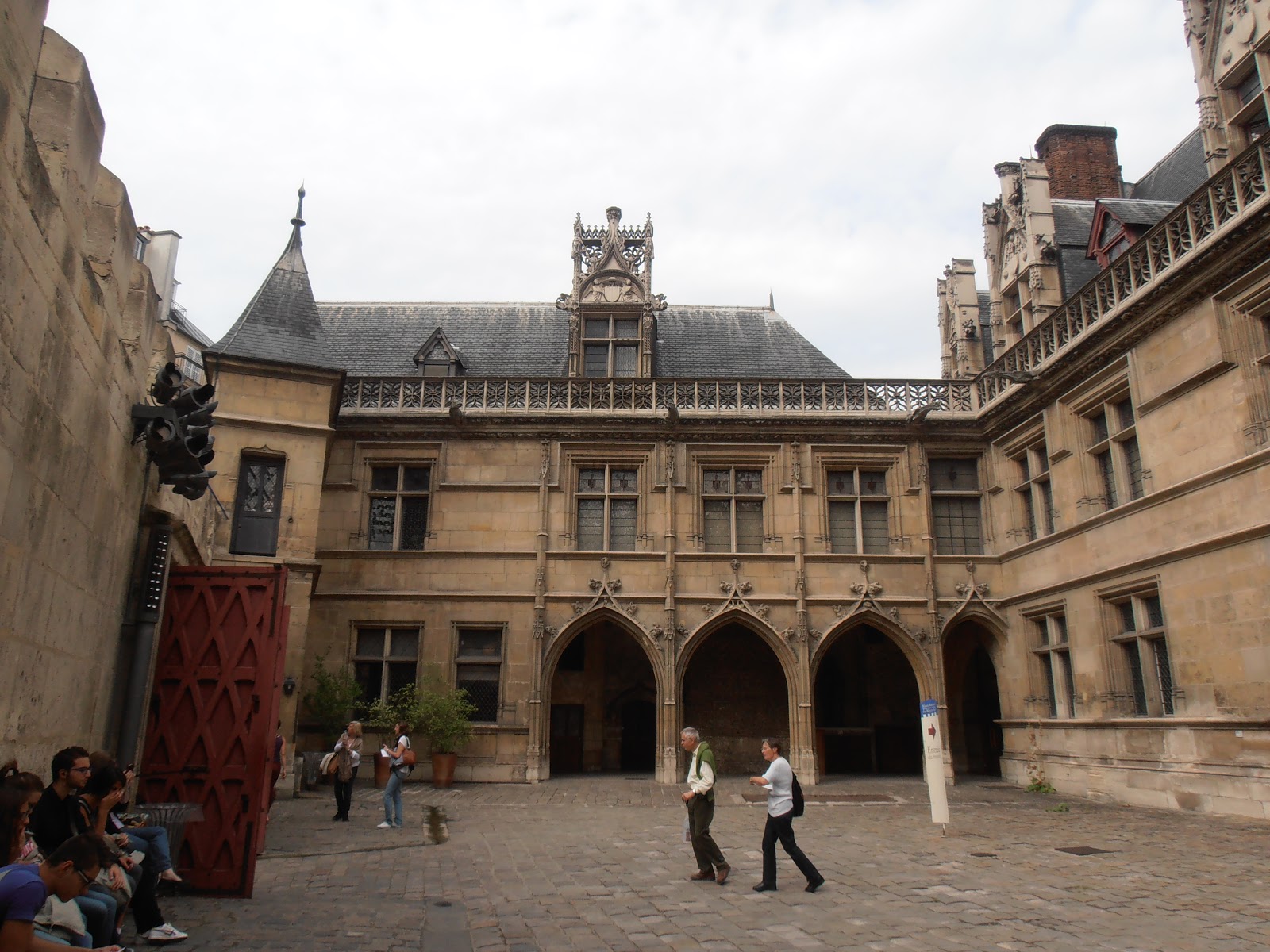
The Musee is structurally the most fascinating accretion of history, from the original Gallo Roman baths dating from 200 AD to the 15th century Hotel de Cluny, its flamboyant Gothic features preserved and restored in the 19th century. It was home to Alexandre du Sommerand from 1833 to 1842, and here he assembled a Mediaeval collection that was purchased upon his death by the State along with the building itself. The treasures that we see today sprang from this embryo, and have been added to over the years through donations and legacies as well as important acquisitions such as the La Dame a la Licorne tapestries in 1882.


Views of the Musee from the courtyard


Evoking the five senses, Sight, Hearing, Taste, Smell, Touch and a sixth entitled A mon Seul Desir, bearing the Coat of Arms of Jean le Viste, the La Dame la Licorne suite originally graced the walls of the castle at Boussac. It was discovered there in a deteriorated state by Prosper Merimee and Georges Sand in the 1840s, and their efforts played a part in the recovery and subsequent recognition and repatriation of the tapestries as major works of art. Believed to be woven as a wedding gift for the family of Jean le Viste in the 1500s, we are still charmed by the enchanting animals and flowers, the spaciousness and balance of the composition, and the supreme labour manifest in this extraordinary expression of love.


Hearing

Entering the low light of the oval room that houses the famous suite is magical, the magnificence of their glowing presence permeating all. We studied at length the details of superbly refined and exquisite weaving, surely the high point of expression in this medium. Within the sensuality of the flowering garden and the "millefleurs" background the five senses are represented as -

Sight - the lady gazes at the unicorn and holds a mirror in which he observes his own reflection.

Hearing - the lady plays a small portable organ while the maidservant works the bellows.

Taste - the lady picks a sweet out of a golden dish to feed to the parrot perched on her left hand.

Smell - the lady makes a crown of carnations, inhaling their scent while the monkey sniffs a rose from her basket.

Touch - the lady holds an emblazoned banner in her right hand and caresses the unicorn's horn with her left.

A Mon Seul Desir - the lady is either taking or replacing a necklace from a box of jewels. The "sixth sense" illustrated the tapestry could be interpreted as intelligence, wisdom or the "spiritual heart" that governs the five others.

One of the interesting things we discovered on this visit concerned the state of the re woven borders added as restoration in the late 19th century. I had always wondered why these ostensibly newer additions were more faded than the originals. And the answer? The yarn was dyed with chemical dyes as opposed to the natural ones used in the 15th century that have retained their vibrant colour. 


After taking our fill of these wonderful works we moved slowly on through the wealth of small rooms richly decorated with contemporaneous suites of tapestries including The story of St. Stephen, The story of St. Peter, The Offering of the Heart and Aristocratic Life. As well as the tapestries the Musee houses an abundance of Mediaeval craftsmanship - enamel and metalwork, ivories, stained glass, embroidery and sculpture dating from the fifth century.


Manorial Life

Ceiling of the Chapel


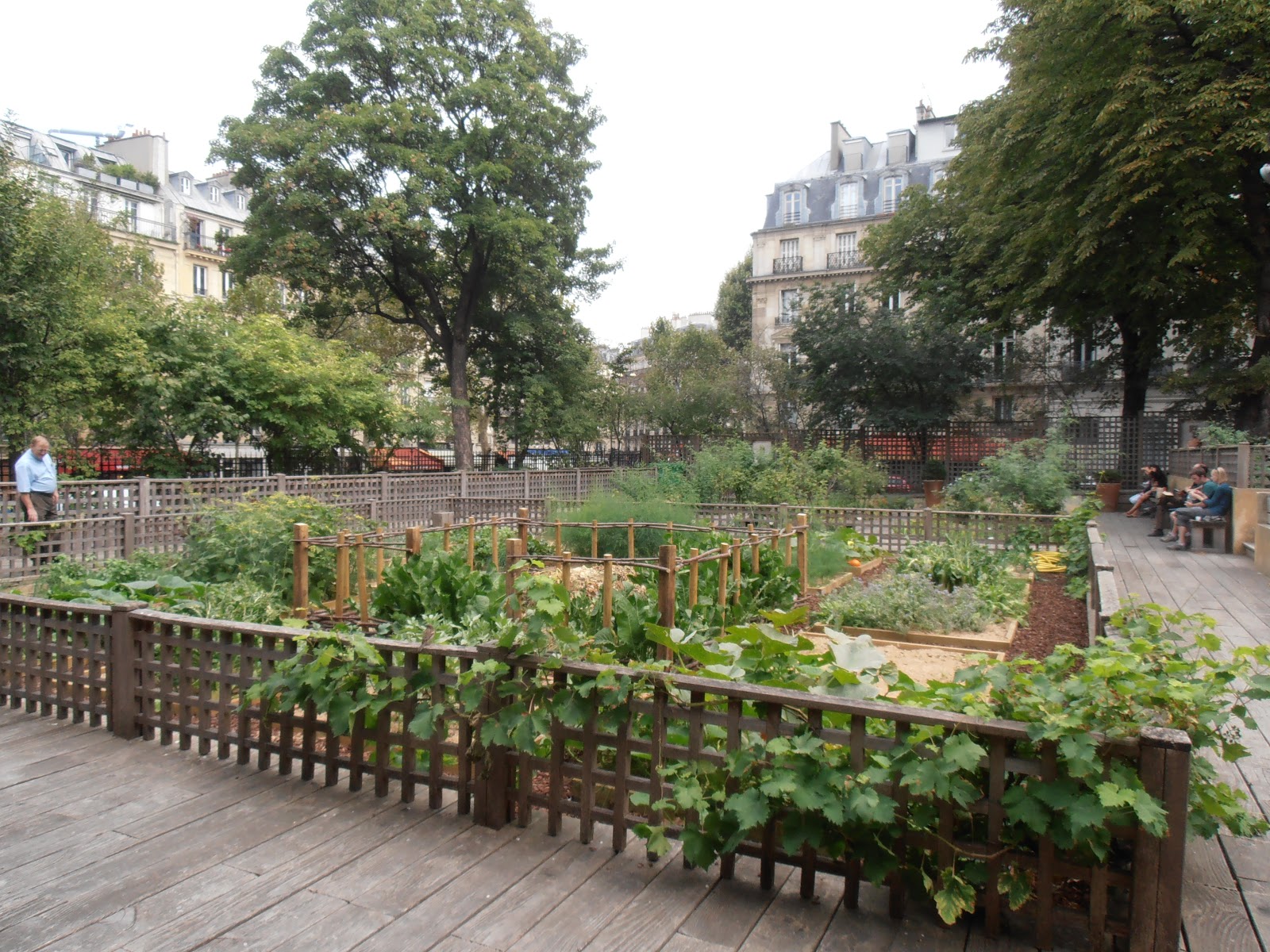
We lunched in a brasserie across the road and then made our way back to view the garden, bounded by the boulevards St. Germain and St.Michel.  Opened in 2000, the garden is designed to resonate with the Musee collection and provide respite from the busy contemporary world that surrounds it. Drawing inspiration from the treasures within, it includes medicinal plants, a celestial garden where flowers such as lilies and irises symbolise the Virgin Mary, and a garden of love reflecting courtly pastimes. A "millefleurs" flowerbed directly references the wonderfully complex floral background motifs of the tapestries.


Lunch


Views of the garden and back of the Musee